Throughout their working years, most people focus on saving enough income for retirement. They calculate a number they need to achieve—through their pension benefit, Social Security, and personal savings—to maintain their lifestyle throughout retirement.
But what happens after you reach that number?
One part of retirement planning that’s often overlooked is maintaining the purchasing power of your retirement income throughout your lifetime. Rising prices and inflation can very quickly erode the value of your retirement income, especially during periods of consistently high inflation. Even a modest rate of inflation can significantly impact your purchasing power over time.
For example, let’s say you retire at age 62, with a benefit of $2,000 per month. And let’s say that inflation averages about 3% per year after you retire. The chart below shows the impact that this 3% annual inflation rate has on your purchasing power.
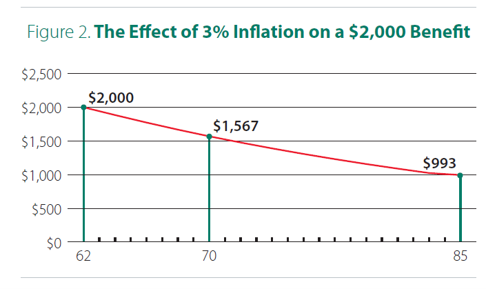
In this example, if you didn’t receive a COLA, your purchasing power will fall to about $1,500—a 22% drop!—by age 70. By the time you reach age 85, which happens to be the average life expectancy, your purchasing power will fall to just $993: less than half the value of your initial benefit. Again, this means that you will be able to purchase only half the amount of goods that you were able to buy when you retired.
And if you were to live past 85, you would experience even greater reductions in purchasing power. Without a cost-of-living adjustment (COLA), the rising cost of goods and services can erode your retirement income to the point that benefit that was perfectly adequate to pay your monthly expenses when you first retired can become inadequate over time.
About LAGERS’ COLAs
LAGERS is designed to help protect retirees from the effects of inflation. COLAs are granted each year at the discretion of the LAGERS Board of Trustees who take into account the financial health of the entire LAGERS system. The percentage increase of LAGERS’ COLA is based on the Consumer Price Index (CPI) over the 12 months ending in June 2026. This year, the board approved the maximum adjustment for retirees.
Unlike many pension systems, LAGERS uses a cumulative cost-of-living adjustment. This means that even though Missouri state law prevents adjustments from exceeding 4% in a single year, LAGERS will continue granting adjustments each year until you reach 100% of the purchasing power of your original benefit.
For example, if CPI reaches 5% one year and 2% the following year, you would receive a 4% adjustment for the first year and a 3% adjustment the second year. If CPI remains over 4% for multiple years, you will receive the maximum adjustment until you are caught up. Because LAGERS COLAs are cumulative, each year’s increase is applied to your current benefit, including previous COLA increases. This means that your adjustment builds over time.
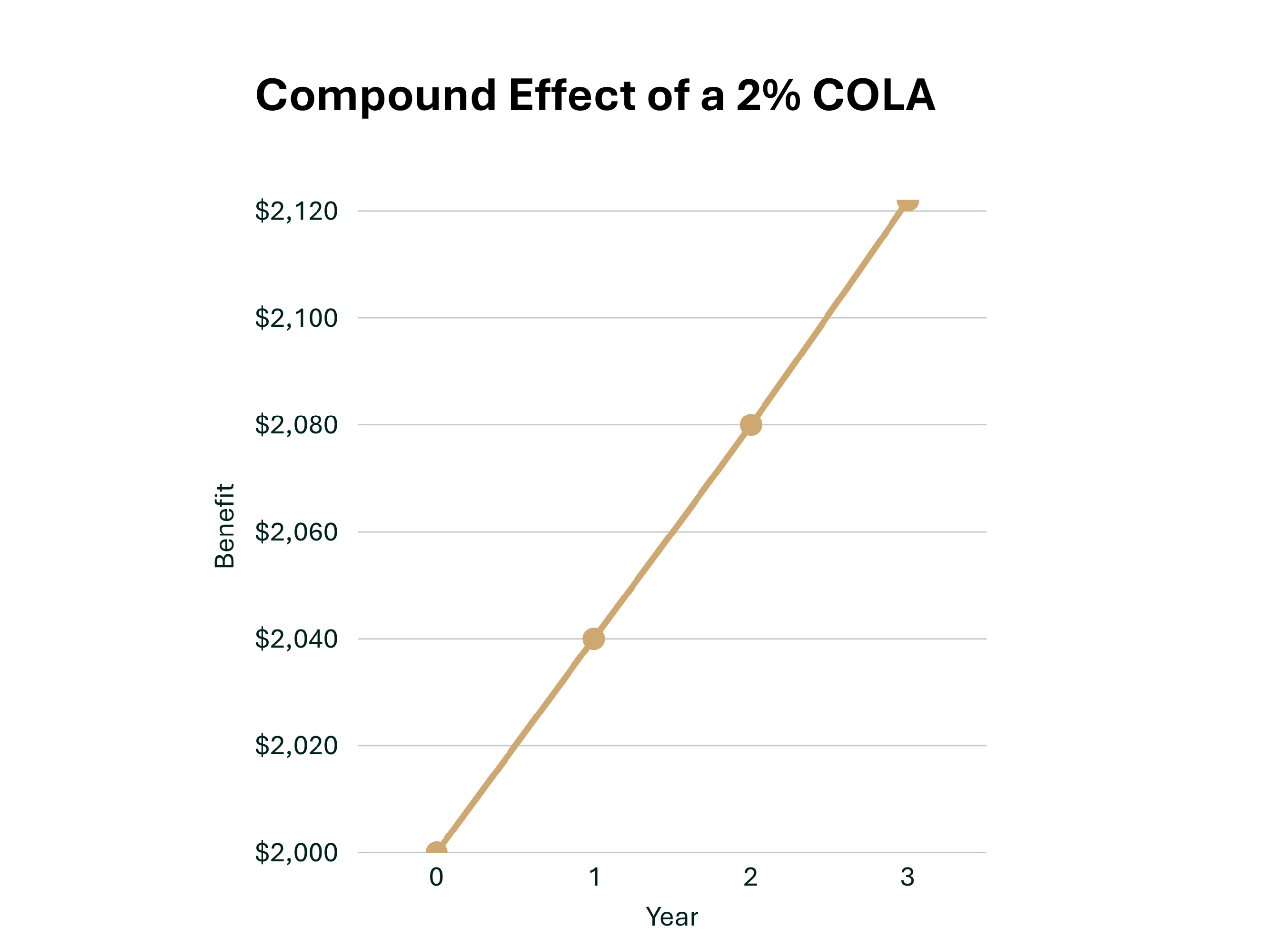
For example, a retiree with a $2,000 monthly benefit who receives a 2% cumulative COLA would see their benefit increase to $2,040 in the first year. The following year, the 2% increase is applied to $2,040—not the original $2,000—resulting in a benefit of $2,080.80. Over time, these compounding increases help your retirement benefit keep pace with inflation.
Cumulative COLAs are increasingly rare across the country and require a retirement system to have a well-designed plan structure.
LAGERS maintains a separate fund called a Benefit Reserve Fund (BRF) dedicated exclusively to retirees and their beneficiaries. This structure allows the board to grant COLAs year after year and protects our retirees’ purchasing power. The BRF is currently 113.8% funded and has a reserve of $827 million.
LAGERS also has no lifetime cap on cost-of-living adjustments. Many retirement systems have a lifetime percentage cap that would prevent your benefit from increasing more than a certain percentage of its original amount. The cumulative effect of receiving a COLA each year, even with a 4% cap, has a drastic impact on a retiree’s ability to maintain their standard of living.
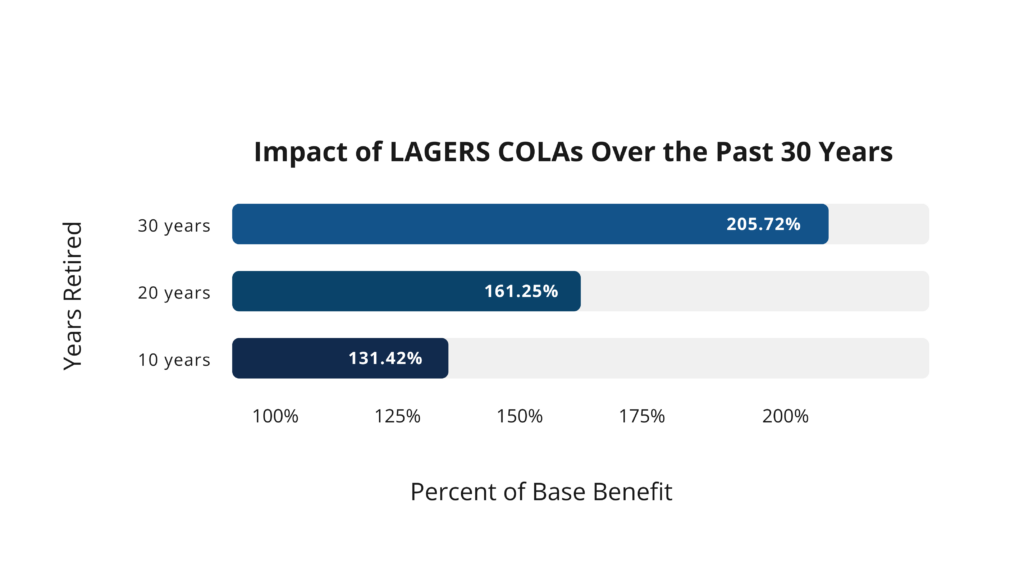
The cumulative impact of annual COLAs can be significant. Today, retirees who have received cumulative COLAs for:
10 years are receiving 131.42% of their base benefit
20 years are receiving 161.25% of their base benefit
30 years are receiving 205.72% of their base benefit
As of 2026, the longest-retired LAGERS member who retired in 1981 is receiving 379.45% of her original base benefit.
Having a retirement benefit that can keep up with rising costs remains one of the most powerful aspects of being a LAGERS member. At LAGERS, we know that COLAs provide a crucial financial cushion that allows you to retain full purchasing power with your hard-earned benefit, even as the cost of living fluctuates from year to year.