
Christopher Nolan’s Odyssey has recently taken the box offices by storm, and one of the story’s most famous images feels especially relevant: Odysseus, lashed to the mast so he can hear the Sirens without steering the ship onto the rocks, while his crew keeps rowing with wax in their ears. Today’s stock market has its own siren song. It is concentration. It is valuation. It is the belief that AI enthusiasm must either carry the market higher forever or end in a familiar bubble. We hear all of it. We are not ignoring the risks. But hearing the song is not the same as letting it steer the portfolio.
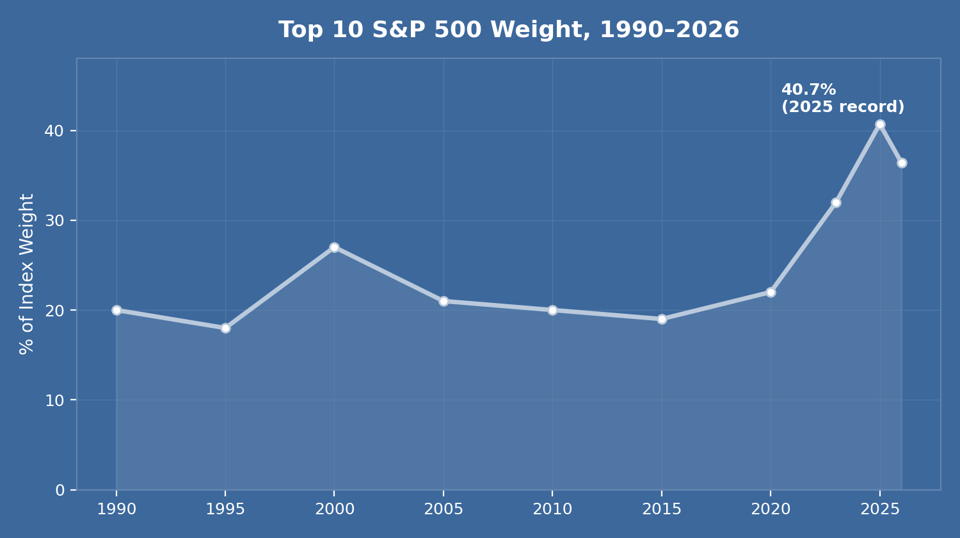
The first verse is concentration. Today, the largest 10 companies in the S&P 500 account for 36%-41% of the index’s weight (depending on the analyst you reference), versus roughly 19% a decade ago. While the index includes more than 500 companies, a relatively small handful of its largest holdings now drive an outsized share of its performance. That does not mean the market must reverse. It does mean the S&P 500 is less diversified than its headline suggests, and a narrow group of companies has become unusually important to overall returns.
The second verse is valuation, with AI as its main melody. The Magnificent Seven are expected to spend north of $700 billion on AI capex this year, and it has pushed the market’s valuation debate toward two opposing camps: AI will justify today’s prices, or a bubble is forming. At the end of 2025, the group traded near 28x forward earnings – rich by historical standards, but still well below the roughly 66x multiple the top seven names carried during the dot-com era in 1999. Sentiment shifts, and so does the tune: one moment it’s capex fatigue, the next it’s a buying opportunity. That is the nature of the Sirens’ song – persuasive in the moment, and certain that this verse is the one that matters. Bubble. Not a bubble. Cheap. Overspending.
None of it tells us when to act. Valuation tells us where risk may be building; price, breadth, and leadership tell us when the market may actually be changing. Don’t forecast, just listen.
Someone always brings up 2000, when the top 10 were about 27% of the index. It’s worth remembering how that one actually ended: breadth and leadership broke down before the valuation crowd got its vindication on paper. The market rolled over on its own schedule, not the crowd’s. We do not need to answer every verse of the Sirens’ song. We maintain discipline as a matter of course, and we adjust course only when the market actually tells us to.
So what do we do with all this? We remain invested, not because the market is without risk, but simply because the Siren verses of concentration and valuation do not drive returns. We continue to monitor prices, breadth, and leadership for confirmation that the market is changing, rather than trying to forecast the exact end of the cycle. Small caps outperforming the S&P this year is exactly the kind of signal we monitor. This means avoiding the temptation to reduce a profitable allocation on the strength of an argument alone, however true it may sound.
Hearing the Sirens is risk awareness. Listening to them is abandoning discipline. Odysseus made it home not by pretending the song was harmless, and not by steering toward it, but by staying lashed to a process while the ship kept moving. We hear every case for why this market should already be over. We take those risks seriously, but we are not letting persuasive arguments replace portfolio discipline. We will keep rowing.

Chief Investment Officer